
Modifying Option-O P100’s exit chute
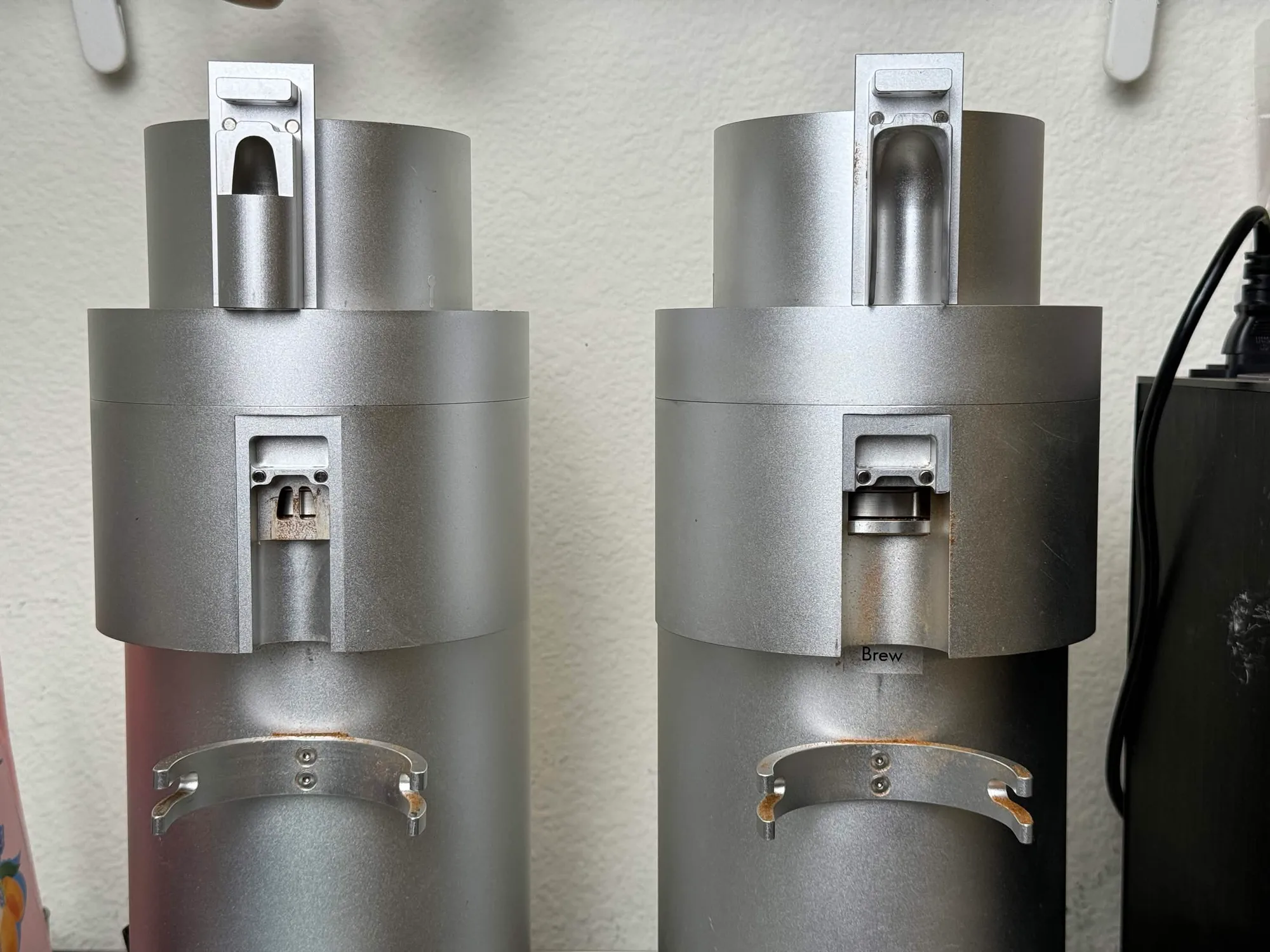
Left: before, right: after. Notice the wider space for grounds to shoot out
Option-O has spent quite a bit of R&D on designing knockers. The P100 appears to have been designed with this iteration in mind, as the exit chute was designed to be removable and exchanged as they iterated better versions.
3 iterations exist:
- The original is spring loaded. Small screws define spring tension. Numerous owners who did not adjust this felt it hurt their thumb for the out-of-factory push force needed to operate it.
- The NEAT clicker, aka the "pimple" button, which loads up spring force to thwack down as the button is fully pressed. This addressed the tension issue, but was hideously unsightly and internally complex.
- The NEAT v2 was the final iteration, which was basically the original's visuals with looser, magnetic snap-back. A screw could be loosened to make the magnet the main holding force, so the "snout" could be removed entirely to clean the chute on the fly. Aside from new users accidentally knocking too hard and unseating the snout, I consider this a fantastic solution.
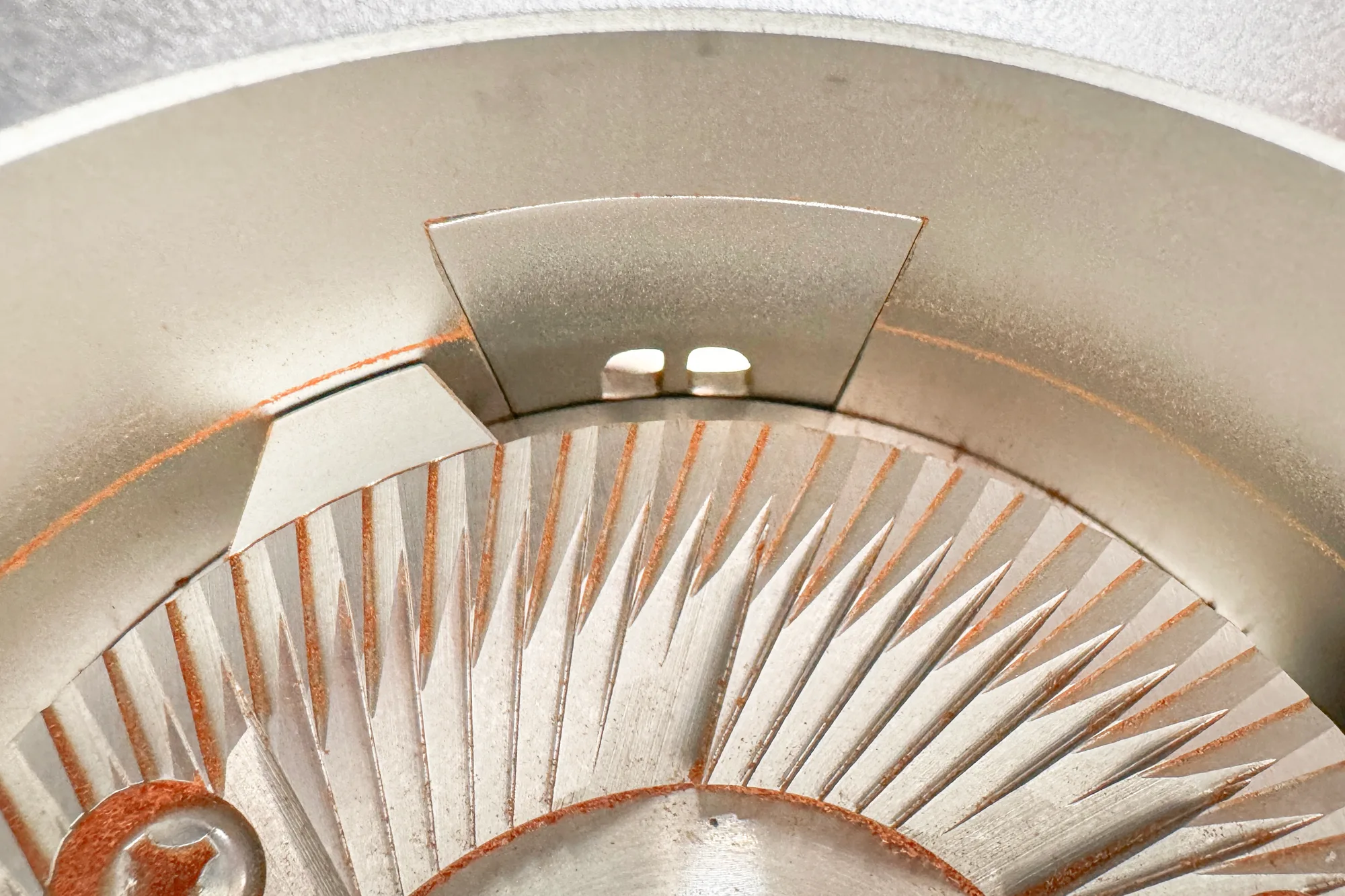
Do you think all the grounds can get out of here?
All of these iterations and subsequent exit chute designs have a common element - a vertical bar, which I term the "nostril", which acts as a declumper so espresso grounds appear fluffier.
As I spent hours swapping and aligning burrs and staring into the P100's inner chamber, my skepticism grew that each quarter turn of the 4 wipers would be able to get the ground material through the exit hole.
At the time in 2023, I'd been slow-feeding by hand to lighten the incoming load into the burrs, but I felt that I was rate-limited; the outfeed rate was the problem, not the infeed rate.
As an example with nice, round numbers, if a grinder system at a given gap and RPM finishes 20g in 5 seconds, you'd expect an average of 4g/sec out. The question for this discussion: can the exit chute handle that same throughput? If not, then you could speculate something is happening to those grounds caught in an increasing traffic jam between the burr exit and the grinder exit.
Since I had several spare old knockers that had no way to be used, I grabbed a dremel tool.
The original plan was to start by knocking out just the nostril bar, but it became immediately clear that the tools I had on hand, even with worn down grind discs, were far too large for this small area. So as a proof of concept, I took it to the extreme and channeled out a looot.
Not pretty! But sufficient as a proof of concept. The exit aperture was huge compared to the stock nostril; no way the grounds' outfeed rate would be limited.
The assembly of the different clicker generations is quite different. As curiosity struck to try another, I was able to purchase another NEAT v2 clicker for testing (Thanks Guy and Sam!). I found those cleaned up much nicer, especially if you were willing to chop off a lot more.
Once reassembled, I could compare them side by side them with 2 copies of SSP 98mm high uniformity in red speed I happened to have at the time.
Now here's where I get apprehensive - I don't think folks should try this. No magic is uncovered from this; we're scraping the bottom of the barrel of optimizations. I strongly prefer and suggest spending time on the top-level things that matter - beans and water. This does not make a "bad" burr geometry shockingly better (I tried with the EK post-2015 B, no luck).
Some observations in lieu of being able to communicate this minute difference
- Towards the end of the grind, there are fewer trailing grounds. More noticeable at slower RPMs where you can see there are fewer quarter turns with just a few grounds coming out. At higher RPMs, there's virtually no time between full output and no more grinds coming out.
- Because there are fewer grounds that need help coming out, I don't use the auto-purge function; nothing comes out when RPMs kick up.
- At coarse pourover settings, I noticed less of an effect in the cup. When going finer, I'd notice drawdown times were a bit faster. Side-by-siding at equivalent settings is not a conclusive way to test, but minute preference went to the opened chute. Call it bias. I didn't re-dial for all the ways the faster flow rate of one could or couldn't be dialed with the original chute.
The impact I want to suggest is a ~2% difference swing in results, tops. For comparison, I'm putting water at a 50-60% swing, bean selection at a 60-70% swing, and optimized brew temp at a 20% possible swing. So in this hand-wavey framework, your time would be poorly spent here if you haven't figured out the rest. Especially water.
One way to interpret this whole project is the mutilation of equipment for fractional differences in cup results. Another is the cleanliness of how it shoots out fines and reduces space for gunky buildup. As a side reminder, for all Option-O grinders, don't knock while the grinder is running.
Each time I open up an Option-O grinder, the nostril is the first thing I look at, I'm checking whether the chute is large enough. Given how efficient 102mm burrs can be, I think the Lagom 01 deserves a larger exit chute. The Lagom P80 also has a narrower hole than I'd like, but I notice the nostril bar is way thinner than back on the P100 and is tilted toward the rotational direction of the burr. Neither of these should get dremel'ed since the exit chute isn't a replaceable part.
If you've got access to more precise tools, you could do a much more elegant job: